Local browser workspace for ideogram metadata cleaner
Ideogram Metadata Cleaner — strip C2PA & container tags locally in your browser
Looking for a fast, private way to handle ideogram metadata cleaner before delivering client graphics, social posts, or campaign visuals? Visuals exported from Ideogram v3, Ideogram v3 Quality, and Ideogram v2 typography and poster models (backed by nearly 250,000 Arena votes across #50, #51, and #67 for graphic design and text rendering) embed structured provenance manifests, software strings, and action timestamps directly inside the file header. Our browser workspace processes ideogram metadata cleaner entirely on your device using client-side WebAssembly and HTML5 Canvas without uploading a single byte to any external server. Drop up to twenty files into the queue below to inspect or clear ideogram metadata cleaner in one pass, toggle optional perceptual-hash pixel noise, and download clean derivatives or a bundled ZIP archive.
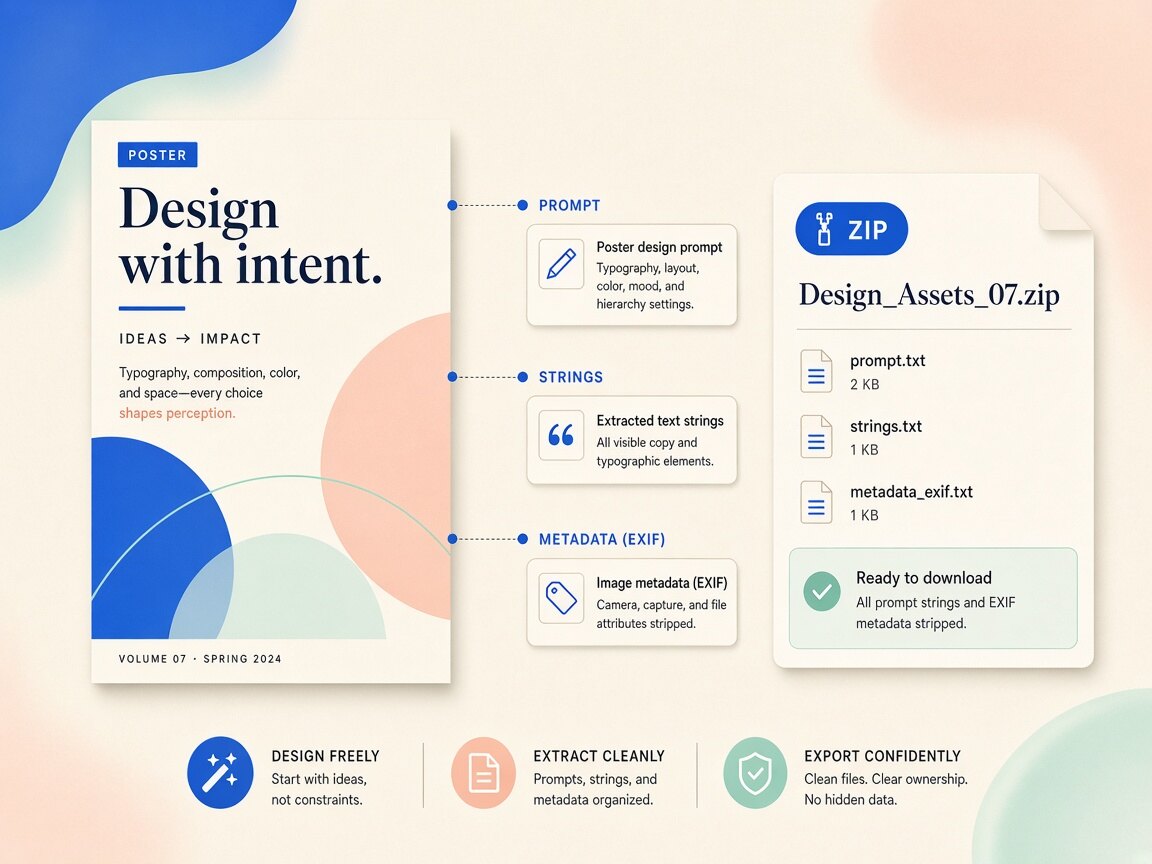
Remove AI & privacy metadata from photos
Files never leave your device. JPEG, PNG, WebP, AVIF, HEIC, Camera RAW · free batch up to 20 + ZIP. RAW decodes locally via libraw → clean JPEG (≤80 MB).
or drag and drop here
HEIC / AVIF / Camera RAW decode locally and export as clean JPEG. RAW uses libraw-wasm in your browser (drops container metadata; does not rewrite proprietary RAW bytes).
Fingerprint protection is on by default: cleaned images get a light pixel-level noise (perceptual hash changes; usually invisible). Uncheck it or choose "Preserve original pixels / quality" for a metadata-only strip when possible.
What
What our ideogram metadata cleaner workspace strips from your files
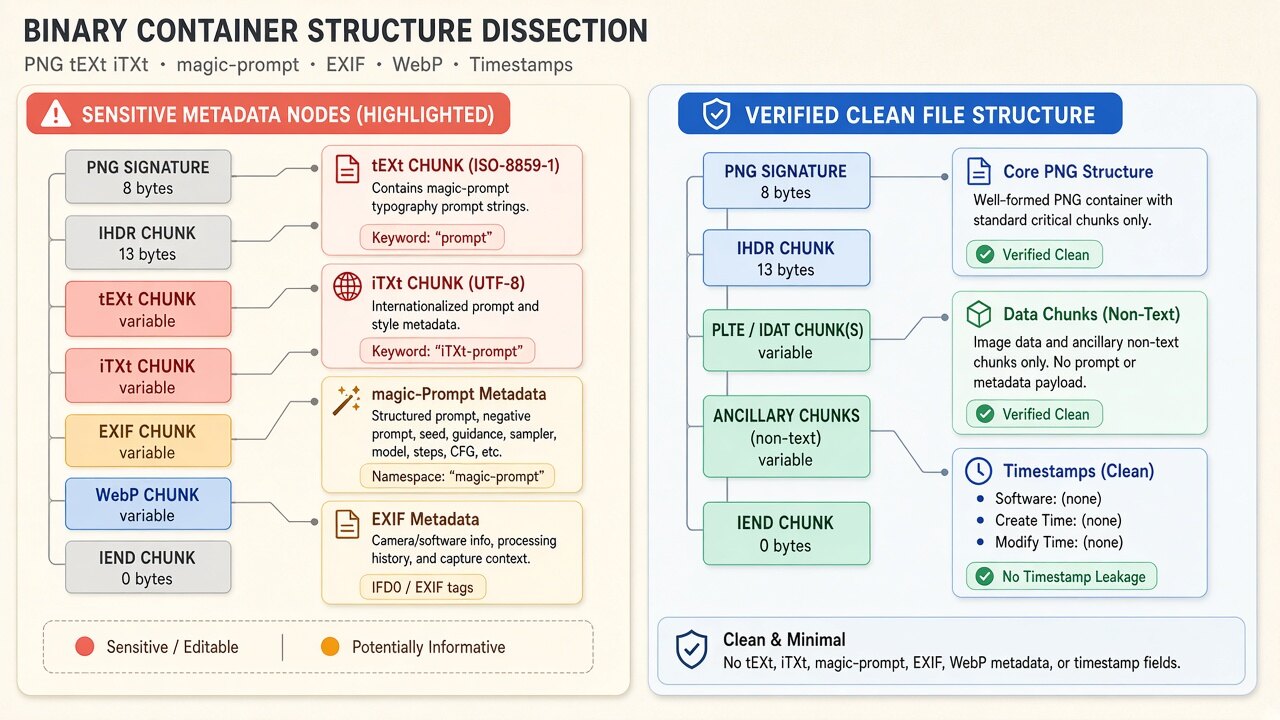
When you run ideogram metadata cleaner through this on-device utility, the browser parses binary segments across PNG, WebP, and JPEG posters, T-shirt graphics, logos, and social cards exported from Ideogram v3 and v2 workspaces. Specifically, our engine targets PNG tEXt and iTXt Magic Prompt strings, typography layout and style-code parameters, WebP RIFF EXIF/XMP chunks, and C2PA provenance headers. Creators and studio teams rely on a dedicated ideogram metadata cleaner workflow so published assets carry crisp visual pixels without leaking internal prompt parameters, API account credits, or editing software trails. Because every step of ideogram metadata cleaner executes inside local browser memory, unreleased creative work never touches a remote cloud bucket.
- Strip C2PA JUMBF superboxes and caBX chunks with ideogram metadata cleaner in one local pass
- Clear XMP DigitalSourceType packets and generator strings via ideogram metadata cleaner
- Remove PNG tEXt, iTXt, and zTXt parameter blocks using ideogram metadata cleaner
- Process up to 20 files per batch with ideogram metadata cleaner and export a local ZIP archive
- Optional pixel-level hash perturbation or strict lossless container mode for ideogram metadata cleaner
- Honest boundaries: ideogram metadata cleaner clears file headers locally; it never alters SynthID pixels
Binary container deep dive
Inside the file headers targeted by ideogram metadata cleaner
Print-on-demand sellers, poster artists, and social marketers love Ideogram v3 for exact lettering and Magic Prompt expansion, yet exported PNG and WebP files frequently store the exact Magic Prompt text string, seed, and style codes inside container headers. Running our browser batch queue strips those embedded prompt strings across twenty designs at once and packages a clean ZIP ready for Etsy, Redbubble, or client delivery. When you audit ideogram metadata cleaner in our read-only inspector or run the cleaning queue, the parser strips APP1, APP11, eXIf, caBX, tEXt, iTXt, and RIFF header segments cleanly. Using ideogram metadata cleaner locally ensures that neither primary EXIF directories nor redundant XMP packets survive in your distributed copies, while keeping your archival master files untouched on disk.
- Inspect and strip APP11 and caBX JUMBF boxes during ideogram metadata cleaner cleanup
- Eliminate dual-written XMP and IPTC algorithmic media tags with ideogram metadata cleaner
- Purge auxiliary PNG text chunks and WebP RIFF headers via ideogram metadata cleaner
- Verify zero remaining header markers in Detect mode after running ideogram metadata cleaner
Studio & publishing workflow
Best practices for ideogram metadata cleaner in client and social delivery
Design agencies, brand studios, and independent creators often keep original exports with full provenance logs inside an internal archive for compliance or version tracking. Before uploading public derivatives to social feeds, portfolio sites, or client portals, running ideogram metadata cleaner creates a clean distribution copy free of container clutter. You can keep the default perceptual-hash perturbation active during ideogram metadata cleaner to shift basic reverse-search hashes, or uncheck it when pixel-for-pixel fidelity is required for print and compositing.
- Archive untouched master renders offline before processing ideogram metadata cleaner for web release
- Use ideogram metadata cleaner batch queues to standardize 20 campaign assets into one clean ZIP
- Toggle pixel-noise protection on or off inside the ideogram metadata cleaner workspace
- Run ideogram metadata cleaner directly in desktop or mobile browsers with zero software installs
Why
Why handle ideogram metadata cleaner locally in your browser instead of cloud uploaders

Zero server uploads for ideogram metadata cleaner
Remote web strippers upload your private renders to third-party cloud queues. Our ideogram metadata cleaner pipeline runs 100% inside local browser RAM so confidential client visuals never leave your hardware.
Complete container hygiene with ideogram metadata cleaner
Basic OS property dialogs ignore C2PA JUMBF boxes, PNG caBX chunks, and WebP RIFF payloads. Running ideogram metadata cleaner here rebuilds clean output files without legacy provenance or software segments.
Honest technical scope on ideogram metadata cleaner
We clearly separate file-level container stripping from pixel-level watermarking. Using ideogram metadata cleaner removes header manifests and tags locally, while never making false claims about SynthID or platform policies.
Fast 20-file batch ZIP for ideogram metadata cleaner
Drag a full set of twenty renders into the workspace to execute ideogram metadata cleaner in seconds, then grab individual clean files or a single consolidated ZIP package.
How
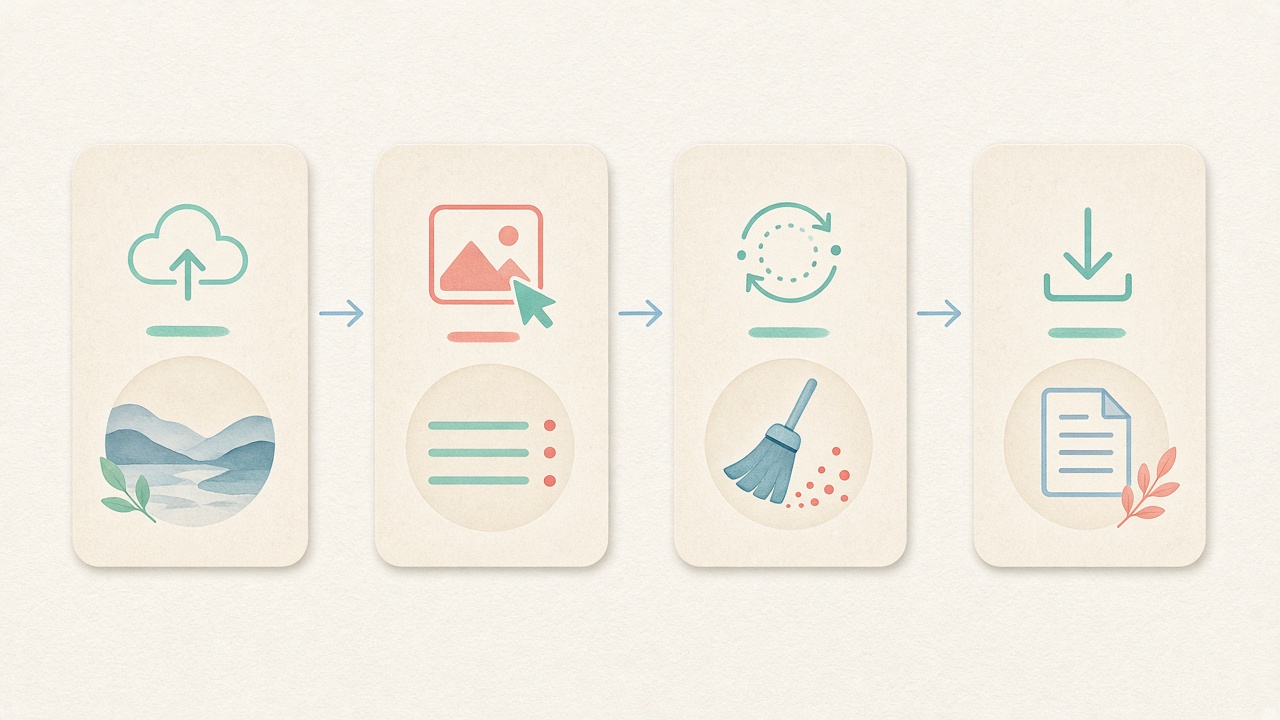
How to use this ideogram metadata cleaner workspace in four steps
- Step 1
Open the embedded ideogram metadata cleaner tool
Stay right on this page—the local ideogram metadata cleaner workspace is loaded below the hero section with no signup, paywall, or desktop installation.
- Step 2
Choose your ideogram metadata cleaner pixel mode
Keep light fingerprint perturbation enabled to shift perceptual hashes during ideogram metadata cleaner, or select original pixel preservation for a strict header-only strip.
- Step 3
Drop files to inspect ideogram metadata cleaner
Drag up to twenty PNG, WebP, JPEG, AVIF, or HEIC files into the browser queue to review detected C2PA, XMP, and EXIF fields before cleaning ideogram metadata cleaner.
- Step 4
Clean ideogram metadata cleaner and download ZIP
Click Clean to strip ideogram metadata cleaner locally in browser memory, verify the byte reduction summary, and save individual files or a packaged ZIP.
Use cases
Who relies on our ideogram metadata cleaner workflow

Creative agencies & brand designers
Agencies prototyping concepts with Ideogram v3, v3 Quality, and v2 use ideogram metadata cleaner cleanup before sending presentation decks and web assets to external stakeholders.

E-commerce & catalog production teams
Storefront operators strip container bloat and software headers with ideogram metadata cleaner so product graphics load quickly and maintain consistent file structures.

Social media & growth creators
Creators publishing across X, Instagram, Pinterest, and TikTok run ideogram metadata cleaner locally to clear header manifests and optionally shift perceptual hashes before posting.

Prompt engineers & workflow builders
Specialists who spend hours refining prompts and seeds use ideogram metadata cleaner to strip auxiliary PNG text chunks so exported samples do not leak proprietary parameters.

Editorial & publishing desks
Digital publishers standardize incoming illustrations with ideogram metadata cleaner to ensure uniform container hygiene across multi-author content pipelines.

Privacy-conscious everyday users
Anyone sharing personal creations on community boards or group chats can clear ideogram metadata cleaner in seconds on desktop or mobile without creating an account.
Voices
What people say
Illustrative examples for layout — not verified customer reviews. No star ratings.

Maya R.
Product photographer
“I needed GPS gone before client galleries. Local batch + ZIP is exactly what I wanted.”

Jordan K.
Etsy seller
“Phone photos had home coordinates. Cleaning in the browser means I never upload originals to a random site.”

Alex T.
Social designer
“Clear about C2PA containers vs SynthID. I use Detect first, then Clean — no surprise claims.”

Sam L.
Freelance editor
“Fingerprint protection on by default is nice for reverse-image risk; I turn it off when pixels must stay exact.”

Riley P.
Content creator
“Video and PDF in the same local tool means I am not juggling three upload sites for one launch.”

Casey M.
Marketplace ops
“Batch-cleaning GPS before listing photos is now a fixed checklist step. Free limits cover our small team.”
Related
Related guides & tools
- Open cleaner
Jump to the embedded workspace to process ideogram metadata cleaner locally.
- Clean metadata
Strip EXIF, GPS, C2PA containers locally.
- Detect markers
Inspect EXIF, GPS, and C2PA containers on-device.
- What is C2PA?
Content Credentials containers explained honestly.
- What is SynthID?
Why metadata tools cannot remove pixel watermarks.
- Instagram metadata
Privacy before you post.
Ready to clean ideogram metadata cleaner locally in your browser?
Use the embedded workspace above to inspect and strip ideogram metadata cleaner across up to 20 files at once — free, zero server uploads, with instant ZIP export.
FAQ
Frequently Asked Questions About Ideogram Metadata Cleaner
- Can I process ideogram metadata cleaner without uploading my files to a remote server?
- Yes, every step of our ideogram metadata cleaner workflow runs locally inside your web browser after the page finishes loading. We use client-side WebAssembly modules and HTML5 Canvas in device memory so your files are never transmitted across the network. This zero-upload architecture makes ideogram metadata cleaner safe for confidential client projects and unreleased commercial artwork.
- Which specific binary chunks and provenance tags does ideogram metadata cleaner remove?
- Our ideogram metadata cleaner engine strips C2PA JUMBF superboxes (JPEG APP11 and PNG caBX), XMP provenance packets, IPTC DigitalSourceType declarations, EXIF Software headers, and PNG tEXt, iTXt, or zTXt parameter chunks. When you clean exports from Ideogram v3, v3 Quality, and v2, all readable header directories are omitted from the new derivative. You can inspect the exact list of detected fields in the table before confirming your ideogram metadata cleaner pass.
- Does running ideogram metadata cleaner reduce visual resolution or degrade picture quality?
- No, pixel dimensions and visual clarity remain intact when you process ideogram metadata cleaner in your browser. By default, the workspace applies an imperceptible pixel-noise layer to shift perceptual hashes, which you can uncheck whenever you want strict pixel preservation. With that option unchecked, ideogram metadata cleaner performs a clean container strip while keeping visual fidelity as exact as the format allows.
- Will this ideogram metadata cleaner tool remove Google SynthID or invisible pixel watermarks?
- No, and we state this boundary upfront: ideogram metadata cleaner only strips file-level header containers such as C2PA manifests, EXIF directories, and XMP packets. Frequency-domain watermarks like Google SynthID are embedded directly into pixel color values rather than file headers, so no container utility can erase them. Similarly, clearing ideogram metadata cleaner does not guarantee how third-party social networks choose to classify or label uploaded media.
- How many files can I clean at once in the free ideogram metadata cleaner batch queue?
- You can drop up to twenty files into the free ideogram metadata cleaner queue at one time with no account signup or subscription wall. Once local processing finishes, you can download each cleaned derivative individually or click Download ZIP to save the entire batch in one archive. If you have larger studio folders, simply run additional twenty-file ideogram metadata cleaner batches back to back.
- How can I verify that all header tags are gone after running ideogram metadata cleaner?
- After you finish ideogram metadata cleaner and save your cleaned file, switch to the read-only Detect mode at the top of the workspace and drop the exported derivative back in. The local inspector re-parses the binary structure and confirms that C2PA JUMBF boxes, XMP packets, EXIF tags, and PNG text chunks are absent. This gives you immediate, verifiable proof that your ideogram metadata cleaner cleanup succeeded before publishing.
- Why do exports from Ideogram v3, v3 Quality, and v2 contain hidden provenance headers in the first place?
- Modern generative platforms embed C2PA Content Credentials, XMP CreatorTool strings, and IPTC algorithmic media tags to document origin and software versions inside the file wrapper. While useful for internal archive tracking, those headers also expose workflow details, creation timestamps, and generator identifiers when files are shared publicly. Running a local ideogram metadata cleaner pass lets you keep master files archived with full logs while distributing clean public copies.
- Does this ideogram metadata cleaner workspace work on mobile browsers like iOS Safari and Android Chrome?
- Yes, the ideogram metadata cleaner interface is fully responsive and executes in modern mobile browsers on iPhone, iPad, and Android devices. Because mobile browsers support the same local Canvas and WebAssembly APIs as desktop browsers, your phone processes ideogram metadata cleaner directly in local memory without uploading photos over cellular data.
Privacy utility for files you hold locally. Running ideogram metadata cleaner strips file-level header containers and C2PA/XMP/EXIF markers; it does not remove SynthID or pixel watermarks, does not perform cryptographic C2PA validation, and never guarantees platform labeling outcomes.